News
The Ombudsman calls on the National Assembly to take urgent legislative action on key issues affecting citizens
7 May 2026
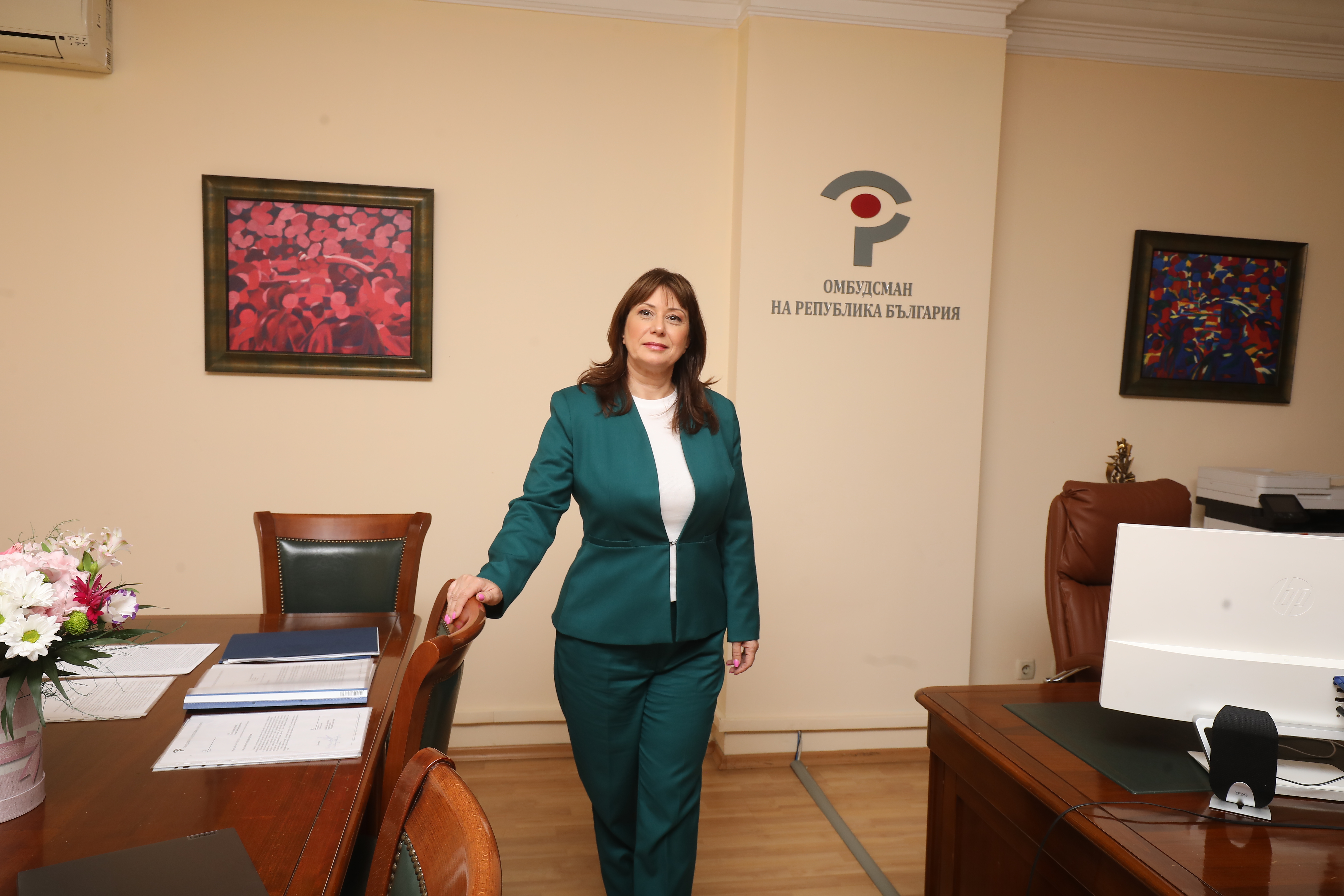
Ombudsman Velislava Delcheva sent an official letter to the 52nd National Assembly Chair, Mihaela Dotsova, and the members of parliament, in which she outlined the main issues raised in citizens’ complaints to the Institution. In the letter, Delcheva emphasized the need to take urgent legislative action to protect people’s rights.
The letter was prompted by the Annual Report on the Ombudsman’s Activities for 2025, which was submitted to the National Assembly on 31 March 2026. The Ombudsman informed the members of parliament that during the reporting period, the Institution received over 10,500 complaints and reports, and more than 102,000 citizens received assistance and support. The report covers a wide range of cases involving violations of rights, in many of which the Ombudsman took the initiative and took action to protect the public interest.
Velislava Delcheva points out that there has been a significant increase in complaints related to rising prices of essential goods and services. She notes that in the first few months of 2026 alone, the Ombudsman Institution received over 6,000 reports in which citizens raised concerns regarding price increases of food products, medical devices, pharmaceuticals, electricity, and transportation services. She also highlights the impact on people in small towns, where transportation services are being discontinued due to rising costs.
“In this regard, I am appealing to you to take urgent and effective legislative action to bring the situation under control, particularly with regard to the sharp rise in the prices of food and essential services,” writes Delcheva.
Issues related to the quality of and access to water and sewerage services also feature prominently in the Ombudsman’s letter. She notes that the largest share of complaints regarding violations of consumer rights comes from this sector, citing the lack of access to water in certain communities, as well as the discrepancy between the price and the quality of the service provided.
She also draws attention to the need to protect citizens from the activities of debt collectors and quick loan companies. In the letter, the Ombudsman describes a number of abusive practices, including failure to notify borrowers when debts are transferred, the imposition of unjustified fees, the exertion of psychological pressure, and a lack of transparency regarding the amount and origin of the debts.
In her letter, Velislava Delcheva also addresses issues related to citizens’ social rights—the amount of social assistance, access to social services, and the need for a mechanism to set minimum pensions in line with the poverty line. She also emphasizes the need for legislative changes to ensure equal treatment for people with disabilities.
The Ombudsman also highlights the need for reforms in the area of juvenile justice, as well as the outdated model of judicial disability, which should be replaced with supported decision-making mechanisms that comply with international standards. Delcheva also emphasizes the rights of patients with mental illnesses, including the need to regulate the application of coercive measures and to establish mechanisms for protection in cases of rights violations.
In the area of property rights, the Ombudsman highlights the need for legislative regulation of land restitution and for safeguarding the rights of citizens with recognized claims, as well as for introducing a mechanism to assess the proportionality of administrative actions that affect a person's sole residence.
In connection with the recent parliamentary elections held on 19 April 2026, the Ombudsman also notes the need for changes to the election legislation in order to ensure the full exercise of voting rights, including for Bulgarian citizens abroad and for people with sensory impairments.
In conclusion, the Ombudsman expresses her readiness to cooperate with the National Assembly.
“In my capacity as Ombudsman, I am ready to actively contribute with specific proposals and opinions on all issues that directly affect the rights and freedoms of Bulgarian citizens,” Delcheva writes.
She emphasizes that the Ombudsman Institution will continue to fulfill its role as an independent defender of citizens’ rights and will bring issues of key public importance to the attention of the legislature.
OMBUDSMAN'S RECEPTION-ROOM
- address: 22 George Washington str.,
1202, Sofia - phone: (+359 2) 810 6955; fax: (+359 2) 810 6963
- e-mail: priemna@ombudsman.bg
PRESS CENTER OF THE OMBUDSMAN
- phone: (+359 2) 810 6913
- e-mail: press@ombudsman.bg